

A Diaspora Experience
By Dr. Shirin Zarqa-Lederman
Somewhere between here, there, and everywhere, there are stories worth telling.
A Diaspora Experience is a collection of personal essays exploring the intersections of faith, family, psychology, liberation, diaspora and belonging. Some reflections draw on the stories we inherit and the relationships we navigate. Others question what psychology has taught us about healing, resilience, and adapting to circumstances we probably shouldn't have to adapt to in the first place. And then there is diaspora itself; the complicated business of belonging to more than one place, carrying memories that aren't entirely our own, and trying to make sense of identity, home, and everything in between.
These essays are part personal reflection, part professional curiosity, and occasionally an attempt to find a little humor in the absurdity of it all. I hope you enjoy reading them as much as I've enjoyed writing them. And perhaps, somewhere along the way, you'll find a little something of yourself in these stories, too.
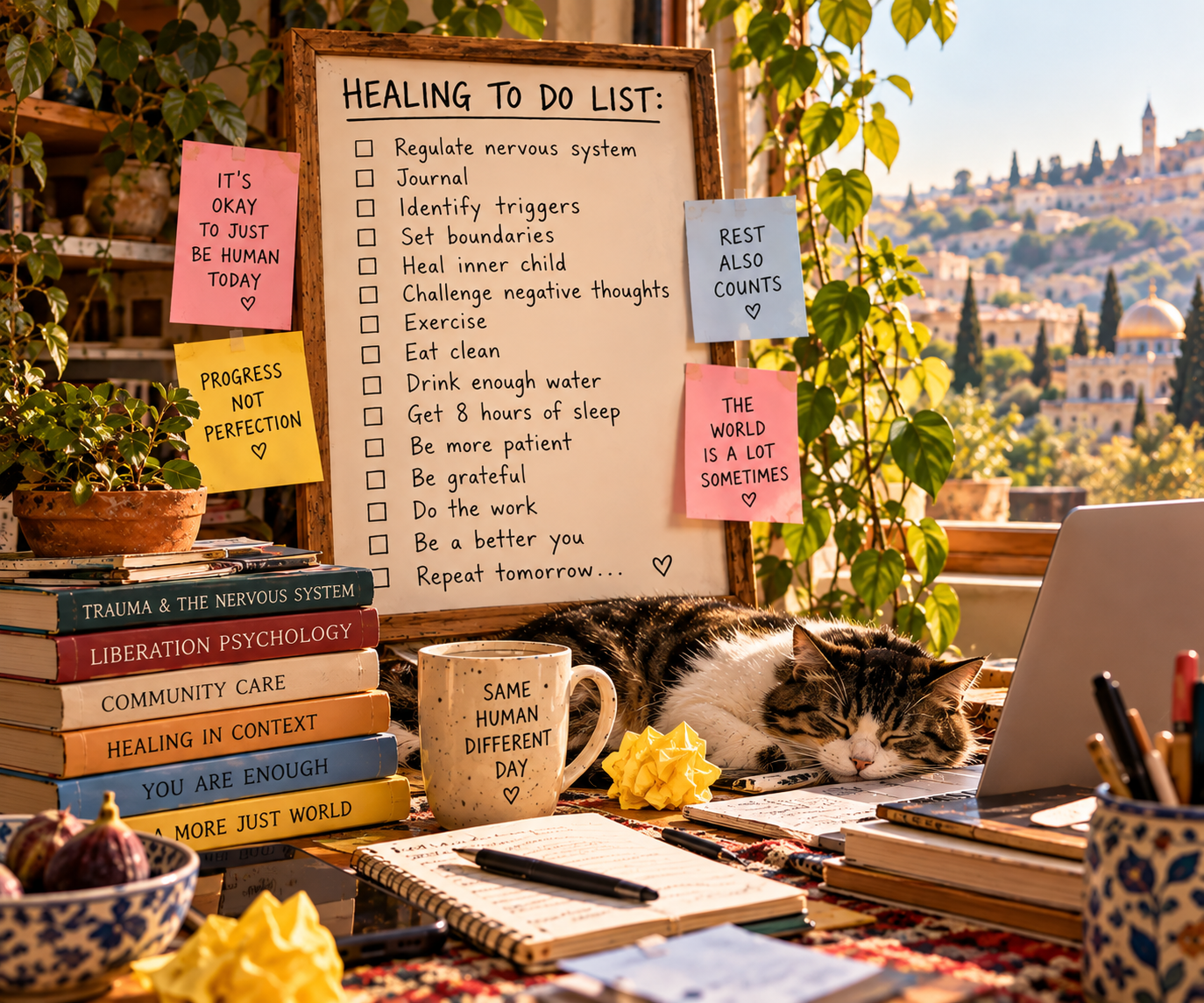
Who Decided Healing Was a Full-Time Job?
What concerns me isn't the desire to heal. It's the assumption that healing is an individual obligation and that continued suffering somehow indicates insufficient effort. Consider how often we hear someone described as needing to "do the work." The phrase has become so familiar that we rarely stop to ask what it means. Sometimes it refers to the difficult and necessary process of examining our behavior, acknowledging harm, and making changes. Other times, it seems to suggest that anyone experiencing distress simply hasn't invested enough energy in becoming a better version of themselves. I've heard people speak about healing almost apologetically, as though their inability to feel better is evidence that they haven't tried hard enough. And I wonder when we became so uncomfortable with the possibility that someone might be struggling despite doing everything they reasonably can.

Have You Tried Deep Breathing While the World Falls Apart?
We've developed an impressive vocabulary for managing distress. We regulate, reframe, practice acceptance, establish routines, challenge negative thoughts, and remind ourselves to focus on what we can control. These are useful tools, and I use many of them in my own practice. But I sometimes wonder whether our enthusiasm for coping has distracted us from asking a more uncomfortable question: What exactly are we helping people cope with, and who benefits when they become better at tolerating it?